
Wading Boots for the South Platte — Brands, Soles, and What Actually Works
The Pikes Peak granite at Cheesman and the cobble at Deckers demand the right wading boot. Four brands compared, felt vs. rubber per river section, and what Renato fishes.
I’ve owned more pairs of wading boots than I’d like to admit out loud — and I’m the guy who preaches owning less. The South Platte’s Pikes Peak granite at Cheesman Canyon and the slick cobble at Deckers are as demanding as any wading terrain I’ve been on — one wrong step on wet rock without the right sole and you’re swimming with your fly box. Here’s everything I’ve learned the hard way: which boot, which sole, and why.
The Regulation Question First
Before choosing a boot: Colorado does not ban felt-soled wading boots as of 2026. Some states — Vermont, Alaska, South Dakota — have enacted felt bans due to invasive species transport concerns. Colorado has not. You can legally fish felt soles on the South Platte.
That said, decontaminate regardless of sole type. Rinse thoroughly after every outing, dry completely between river systems, or use approved chemical treatments. The invasive species risk is real even without a legal requirement to address it.
Felt vs. Rubber — Per Section
Sole choice isn’t a single answer on the South Platte. The answer changes by section:
Cheesman Canyon (Pikes Peak granite): This is the one place felt earns its reputation — the granite is irregular and algae-coated, and felt grips it in a way a lot of rubber can’t. Plenty of Cheesman regulars run felt here for exactly that reason, and it’s a fair call. I don’t: I fish rubber everywhere, this rock included, and I pay for it with slow, deliberate feet and a wading staff I actually lean on. I’ve gone down hard on wet Cheesman granite — the kind of fall where you check for witnesses before you check for injuries — and the lesson I took wasn’t switch to felt, it was respect this rock and wade like it’s trying to put you in the river. If you want the surest grip on the granite and you’ll decontaminate every time, felt is the honest answer here.
Deckers (rounded cobble and gravel): Either works. The cobble at Deckers is more uniform than Cheesman rock and rubber soles handle it well. Felt is still marginally better on wet rounded rocks, but if you’re already in rubber, Deckers is comfortable ground.
Dream Stream (soft meadow substrate): Rubber is fine. The Dream Stream doesn’t have hard slick rock. Rubber soles are plenty for meadow-section wading and easier on the approach.
Arkansas River — Pueblo Tailwater: Rubber works. The substrate is more forgiving than Cheesman. Either sole handles the Pueblo section without issues.
Bottom line on soles: I fish rubber, everywhere, no studs. It travels better, it’s the friendlier choice for not moving invasives between drainages, and modern sticky-rubber compounds have closed most of the old grip gap. The one honest caveat is Cheesman granite, where felt does grip better — I make rubber work there with careful wading and a staff. If you fish Cheesman constantly and want maximum grip, felt is a defensible pick; just decontaminate it religiously.
Are felt-soled wading boots legal in Colorado?
Yes. As of 2026, Colorado does not ban felt soles — you can legally fish them on the South Platte. A few states (Vermont, Alaska, South Dakota) have enacted felt bans over invasive species concerns, but Colorado hasn’t. Decontaminate after every outing regardless of sole type.
A Note on Studs
Plenty of South Platte anglers add aluminum studs — screw-in spikes in the sole — to punch through the algae that both felt and rubber can skate on. They do help on slick rock, and it’s a fair choice.
I fish without them. On the Cheesman granite I’d rather rely on careful feet and a wading staff than have metal points chattering across the rock and skating on the hard flat boulders — and in a bad fall, studs on stone are their own kind of liability. If you do want them, Simms sells aluminum bar and hex studs that screw into pre-threaded holes, and Skwala RS boots use the same threaded system; other brands have proprietary setups, so check compatibility before you buy.

The Boots
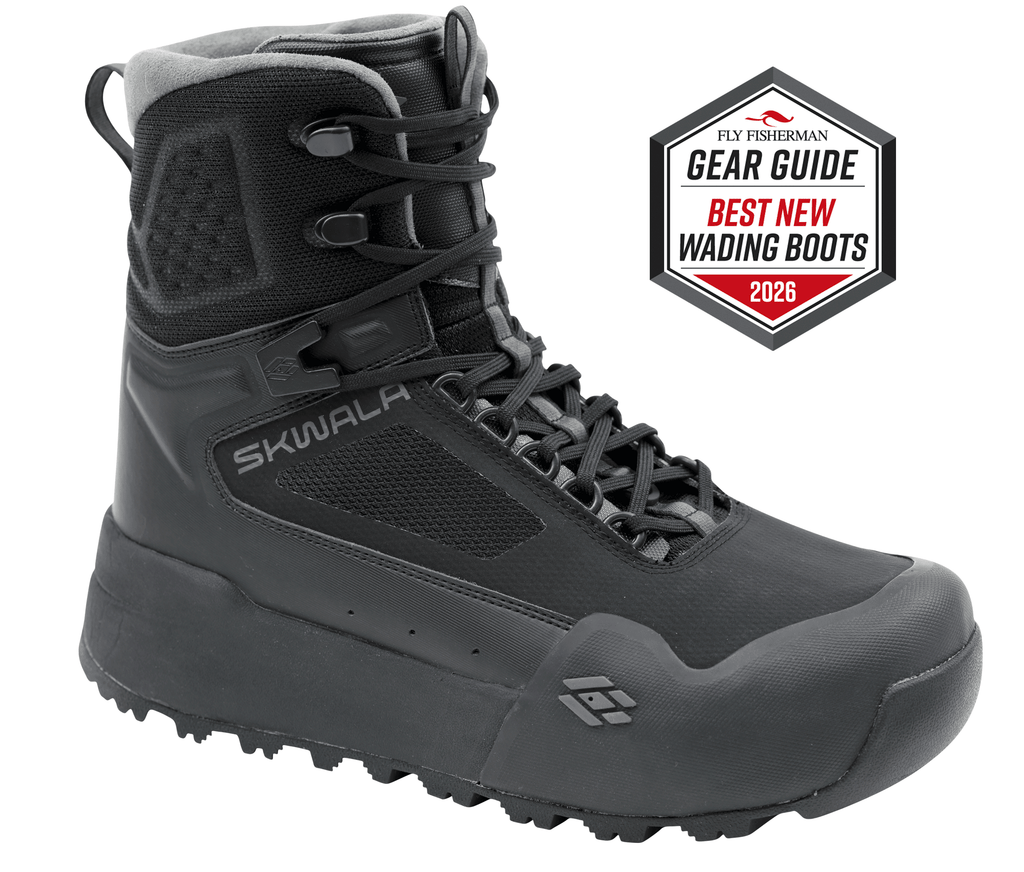
Skwala RS Wading Boots — ~$260
This is what I fish. The RS boot is built for anglers who cover real ground to reach water — the design starts with what you need and leaves out what you don’t.
The ankle support is substantial without making the boot stiff enough to impede trail movement. On the 1.3-mile Cheesman approach over Pikes Peak granite, the RS is walkable in a way the Simms G4 Pro is not. The rand construction wraps the toe and heel with reinforced material that holds up on sharp granite without adding dead weight.
What I notice most after a full day at Cheesman: my feet don’t hurt. Sounds like a low bar, I know — but most boots I’ve owned trip right over it after six hours of varied terrain. The RS fits properly, drains quickly, and doesn’t create pressure points. After two seasons of Cheesman and Deckers use, it shows wear appropriate to the mileage without structural damage.
Available in felt or rubber. I run the rubber, no studs — felt grips the Cheesman granite better if that’s your priority, but I’d rather keep one biosecure sole for every river I fish.
Verdict: The best boot I’ve owned for South Platte fishing.
Simms G4 Pro Wading Boots — $320
The benchmark wading boot in the category. Heavy, stiff, and built to last indefinitely. A full-length shank provides stability on the irregular Cheesman surfaces that softer boots can’t match. Rand protection is excellent. The felt sole option is the classic South Platte guide setup (a lot of guides add aluminum bar studs to it; I fish rubber and skip the studs).
What the G4 Pro does better than the RS: it’s more protective on technical rocky terrain where ankle flex could get you in trouble. The stiffness that makes it clumsy on the approach trail is the same stiffness that locks your ankle on a bad step in fast current. Some anglers — particularly those fishing heavy water or difficult wade crossings — prefer this.
What it does worse: everything involving walking. The G4 Pro on the Cheesman approach is a slog — by the time you reach the water you’ve already done your cardio for the day. At $320, you’re paying for durability and on-water performance, not comfort.
The G4 Pro lasts. Simms offers resoling. If you’re buying one pair and keeping them for a decade, the G4 Pro makes economic sense.
Verdict: Best pure on-water performance. Worst approach comfort. For hard-wading anglers who hike short distances.
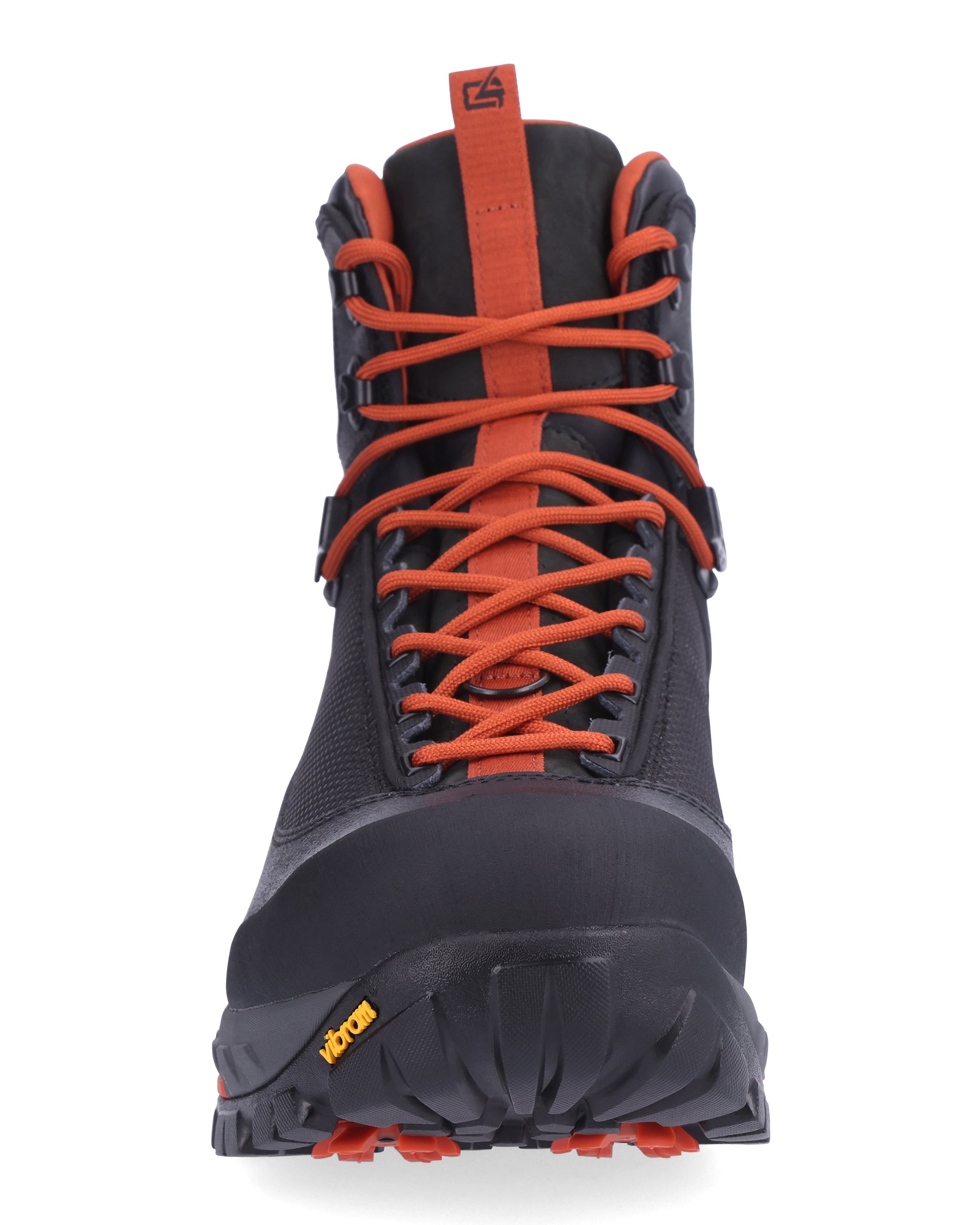
Simms Freestone Wading Boots — $180
The value option in the Simms lineup. Lighter and less structured than the G4 Pro, but the felt sole option and rubber rand toe still make it a legitimate South Platte boot. Not the ankle support of the G4 Pro, but enough for Deckers-difficulty terrain.
For anglers fishing 10–20 days a year who don’t want to spend $300+, the Freestone is the right call. It’s a real wading boot, not a compromise — it just doesn’t have the G4 Pro’s heavy-duty construction. At Cheesman, I’d want the extra support of the G4 Pro or RS. For Deckers and the Arkansas, the Freestone handles it.
Verdict: Best value for moderate-difficulty wading. Solid choice for occasional South Platte anglers.
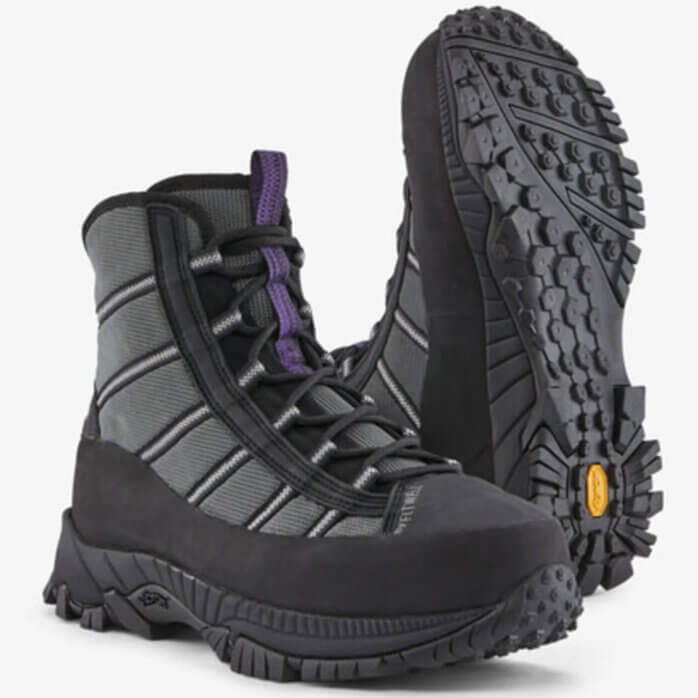
Patagonia Forra Wading Boots — $225
The lightest and most environmentally considered boot in this comparison — recycled materials, available in felt or Vibram. Noticeably more comfortable on the approach than the Simms G4 Pro. Fits narrow to standard width feet well.
Where it falls short on the South Platte: ankle support is less than either the Skwala RS or Simms G4 Pro on technical granite. The rand protection is adequate but not the full wraparound of the other options. At Cheesman Canyon where I’m stepping over and between large irregular boulders, I want more structure than the Forra provides.
For Deckers flat water and easier access sections, it’s completely appropriate. For Cheesman Canyon regularly, spend more.
Verdict: Best value for moderate terrain. Ideal for Deckers-style flat water. Not the call for Cheesman.
Korkers Buckskin — $180
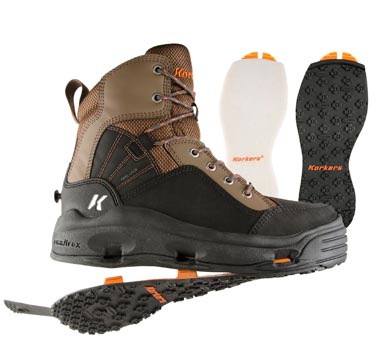
Korkers’ differentiator is the interchangeable sole system. The same boot takes felt, rubber studded, or Omnitrax rubber soles that swap in 30 seconds with a push-button mechanism. One pair of Buckskins covers felt-mandatory canyon water in spring, rubber-appropriate creek fishing in summer, and ice-compatible soles in winter.
The $180 price reflects the construction — the upper material isn’t quite as robust as the Skwala or Simms, but the sole system is genuine and works as advertised. The swap mechanism holds the chosen sole securely through a full day of wading.
For anglers who fish multiple river types across the season, the Korkers argument is compelling. For South Platte specialists who know they want felt every time, the flexibility is a feature you’ll never use — and the construction compromise isn’t worth it.
Verdict: Best for versatile anglers who fish multiple river types. Less compelling for South Platte regulars.
Fit Notes
Wading boots size differently than regular footwear because they’re designed to fit over neoprene or fleece booties attached to your stockingfoot waders.
- Size up at least one full size from your street shoe
- Try boots on with the actual booties from your waders, not in socks
- Check for snug fit without constriction — swelling happens over long wading days
Boots that fit correctly with no booty in the shop often create pressure problems after 6 hours of wading with the booty on. Get the fit right with the full setup.
Durability and Resoling
Quality wading boots last 3–5 seasons of regular use before the sole needs replacement. Simms and Patagonia offer resoling services — paying $80–$100 to resole a $300 boot is significantly better economics than buying a replacement. Send them in before the rand separates.
The most common failure point isn’t the sole — it’s the lacing system and the upper material at the ankle. Rinse after every outing, dry completely before storage, don’t leave them in a hot car. Basic care adds a season or two.
One pair of quality boots bought right beats two pairs of cheap boots that give out mid-season on the Cheesman approach. Buy once, cry once — a phrase I repeat to myself right up until the next pair catches my eye. For the wader side of the complete wading system, the Skwala RS waders review covers the wader I pair with these boots on every South Platte outing.
Skwala’s wading boots are available direct from Skwala. Rocky Drift Co. may earn a commission through affiliate links. Read our disclosure.